
New Volunteers Join Mission Cuba
For many years, Fidesco volunteers have committed two years of their lives to serving Mission Cuba alongside the priests of the Community of Saint-Martin. Through their daily presence, they take part in the life of the mission, both through their work and in parish life. This close involvement allows them to gradually discover the reality of life in Cuba, learn the language and build relationships with the people they meet. As part of the team, they share in both the joys and the challenges of the mission, while building bonds of friendship and fellowship with one another. This year, once again, new faces have arrived in Cuba to take part in this adventure.
Erwan and Juliette: Discovering the Mission
Having married in September, Erwan and Juliette arrived in Cuba on 16 October 2026. They began their mission with an immersion week, their first opportunity to discover Cuban daily life from the inside.
“Just a few days after our arrival, the mission really began: each of us was sent to a different family to experience Cuban life from the inside!
(Juliette) In my case, there were seven of us in the house: the grandmother (87), the woman (30) and her husband (40), her daughter-in-law (20), and her two children (aged 6 and 9). It was a lively home, with a close-knit family who welcomed me as one of their own. They really spoiled me!
Thanks to this week, I realised that everything was different from what I was used to: our relationship with time, organisation, the body, noise, space, money, smells, food… Everything!
I discovered that Cuban houses didn’t have doors and that there were tiled floors throughout the house. Very practical for cleaning them every day with a whole bucket of water!
For both Erwan and me, this week helped us make huge progress in understanding the language. For example, Cubans often don’t pronounce the “s” at the end of words.
It was also an opportunity to discover the basics of the Cuban diet: rice and black beans almost twice a day, accompanied by viandas such as cassava or potatoes prepared Cuban-style. We’ll have to get creative over the next two years to bring some variety to our meals. Quite a challenge for two French people!
(Erwan) I was welcomed by a family of three: a married couple with a four-and-a-half-year-old child. Julio, Helen and Samuel. Their home is on the outskirts of Placetas, where nature is a little more present. They live in a house they have built themselves, little by little, and have a somewhat overgrown garden with… coconut palms, banana trees, guava trees, avocado trees… In short, a very Cuban kind of wilderness!
I had an amazing week, sharing in Julio’s work and family life. They truly welcomed me as a member of their family. It was wonderful to experience such a change of scenery by immersing myself directly in a Cuban family’s daily life.
Of course, it’s quite a shock: all your familiar reference points disappear, and everything is different. But by asking questions and observing, you gradually begin to understand how people live from day to day.
I can’t wait to welcome Julio and Helen into our home one day, or simply to see them again once my Spanish has improved, so that we can build an even stronger relationship with them.”
They will be living in Cabaiguán. Erwan will be responsible for the parish’s construction projects, while Juliette will oversee its educational projects.
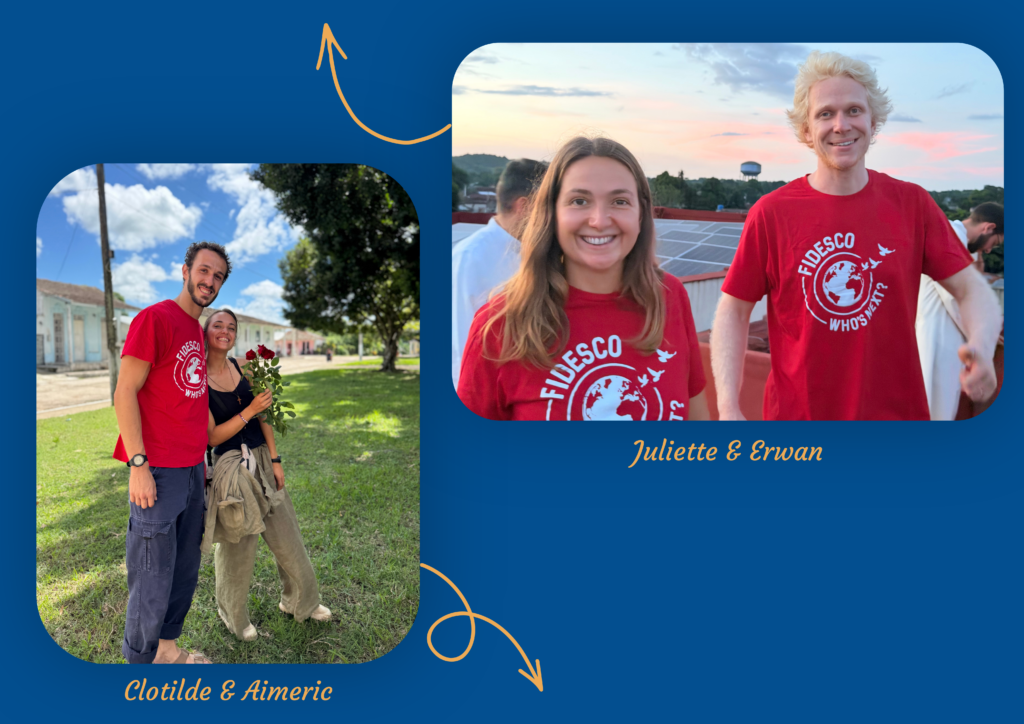
Clotilde and Aimeric: Taking Their First Steps in Cuba
For Clotilde and Aymewic, the first weeks of the mission are an opportunity to find their feet, discover their surroundings and begin meeting the people they will work alongside and share life with over the next two years.
“Poco a poco — little by little.
That’s the answer we give every day to the Cubans who ask us how we’re settling in.
We’ve been married for four months and arrived in Placetas almost a month ago. Little by little, we’re beginning to find our feet in this town, where we’ll spend the next two years alongside the local community. We’re both involved in different areas of the Community of Saint-Martin’s work in the town: Clotilde in accounting and Aymewic in construction. Together, we’re also organising activities for a boarding house for fifteen boys.
Little by little, because getting used to the sounds, smells, language, customs, behaviours, the energy all around us and the food takes time and requires a great deal of energy. When you arrive in Cuba, you have to be ready to go sixty years back in time! Old American cars, power cuts, horse-drawn carriages…
We’re very grateful to the priests, volunteers and Cubans we meet, who are a tremendous help to us and gradually share their advice and experience with us.
Thanks to them, we’re discovering the beauty of the country and its people with a sense of wonder: postcard-worthy landscapes and the warmth and hospitality of the Cubans. But we’re also discovering the stark contrast created by the economic and social crisis the country is currently experiencing. This crisis leads to widespread poverty and many families being torn apart by high levels of emigration.
In this context, “poco a poco” turns out to be much more than a phrase we repeat every day. It is a real lesson in the importance of taking our time, observing and trying to understand what surrounds us, gently and without judgement. “Poco a poco” also teaches us to surrender and place our trust in Christ as we face all these new experiences and the realities of a country that are sometimes beyond our understanding.”